
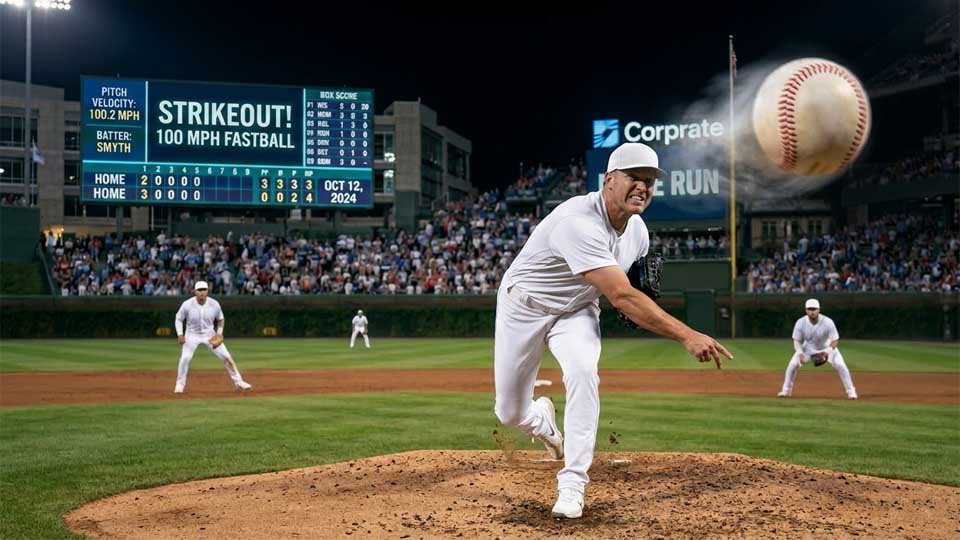
Strikeout Props: Targeting Aligned Pitchers in Excellent Windows Against High-K Lineups
Strikeout props are the cleanest, most pitcher-controlled prop in baseball, and the one most naturally suited to TriSync analysis.
Home runs depend on a collision of bat angle, exit velocity, park dimensions, and wind direction. Hits depend on where the ball finds the defense. Stolen bases depend on catcher arm strength and pitcher slide steps. But strikeouts? Strikeouts are the one outcome a dominant pitcher can impose on the game almost unilaterally. When a pitcher is throwing his best stuff with his sharpest command and his most aggressive competitive edge, hitters don’t just struggle. They swing and miss. They freeze on called third strikes. They flail at sliders that break off the table. The result, a strikeout, is the direct product of the pitcher’s performance, and the TriSync Rating measures that performance readiness with remarkable precision for Aligned arms.
This article gives you a complete system for betting pitcher strikeout props using TriSync Ratings. We’ll cover why the Excellent rating window is the foundational filter for K overs, how to identify opposing lineups stacked with hitters in Suboptimal and Fair windows who are vulnerable to swinging and missing, when to flip the script and bet K unders by fading pitchers in Suboptimal windows, and why strikeout props carry a structural advantage that other props don’t: they’re park-neutral. The ball doesn’t need to travel anywhere. It just needs to miss the bat.
Why Strikeout Props Are the Ideal TriSync Bet
Every prop bet involves a balance between what you can predict and what you can’t. The more random variables involved, the harder it is to find a consistent edge. The beauty of strikeout props is that they strip away most of the randomness that plagues other bet types.
The Park-Neutral Advantage
Home run props are profoundly affected by park dimensions, altitude, and weather. Hits props are influenced by field surface, defensive alignment, and whether balls find holes. Runs and RBI props depend on what other hitters in the lineup do.
Strikeouts don’t care about any of this. A strikeout at Coors Field counts exactly the same as a strikeout at Oracle Park. Wind direction doesn’t affect a swinging strike three on a slider in the dirt. The park’s outfield dimensions are irrelevant when the ball never leaves the infield circle. This park-neutrality eliminates an entire category of variables that plague other props, which means a higher proportion of the outcome is determined by the factors TriSync directly measures: the pitcher’s physical readiness, competitive intensity, and mental sharpness.
For bettors, this translates into a cleaner signal. When the TriSync system says a pitcher is in an Excellent window, the expected increase in performance applies to strikeouts regardless of where the game is played. You don’t need to cross-reference park factors the way you would for a home run or total bases prop. The rating is the primary input, and the matchup is the secondary input. That simplicity makes K props uniquely actionable.
The Pitcher-Controlled Advantage
Baseball is a sport where the pitcher has more individual control over outcomes than any other player. A dominant pitcher facing a .300 hitter can still blow fastballs past him, freeze him with a curveball, or get him to chase a slider off the plate. The batter’s role is reactive. The pitcher initiates every sequence.
Strikeouts amplify this pitcher-controlled dynamic because they require the pitcher to win the at-bat decisively. A ground ball single involves the pitcher making a decent pitch that the hitter puts in play and finds a hole; the defense and luck play a role. A strikeout involves the pitcher either fooling the hitter completely (swing and miss), overpowering him (called strike three on a fastball the hitter can’t catch up to), or sequencing him into a trap (chasing a pitch outside the zone after a setup sequence).
All three strikeout pathways are driven primarily by the pitcher’s stuff quality, command, and game-planning; the exact dimensions that the Capacity, Competitiveness, and Cognitive cycles measure.
The Sustainable Edge Advantage
Because strikeout props depend more heavily on pitcher skill than on environmental or random factors, edges identified through TriSync are more repeatable than edges on other props. A pitcher who strikes out 9+ batters per nine innings over a career does so because of a specific skill set: velocity, movement, command, and the ability to generate swings and misses. When his TriSync Rating confirms he’s in an Excellent window, that skill set is operating at maximum capacity. The result, elevated strikeouts, follows with more reliability than, say, an elevated home run rate from a hitter whose well-struck balls might or might not clear the fence.
Over a full season of betting, this repeatability translates into a tighter distribution of outcomes and a more consistent edge. You’ll still have losing bets. But the variance around your expected win rate will be smaller for K props than for HR props, which means your bankroll management can be tighter and your confidence in the system’s long-term profitability can be higher.
How TriSync Ratings Drive Strikeout Production
Each of the three underlying TriSync cycle components contributes differently to a pitcher’s ability to miss bats. Understanding these connections helps you evaluate why a specific Excellent rating translates into K prop value.
Capacity: Stuff Quality and Velocity
The Capacity cycle reflects the pitcher’s physical readiness, arm strength, explosiveness, stamina, and the body’s capacity for peak output. For strikeout purposes, Capacity is the most straightforward component.
When a power pitcher like Tarik Skubal or Tyler Glasnow is in a Capacity peak, expect fastball velocity at the top of his personal range. A pitcher who normally sits 95-96 mph might touch 97-98 consistently. That extra 1-2 mph doesn’t sound dramatic, but it compresses the hitter’s reaction time by roughly 5-8 milliseconds. At the major league level, where the margin between a swing and miss and solid contact is often measured in single-digit milliseconds, that compression is the difference between a foul ball and a swinging strike three.
Capacity also affects the quality of secondary pitches. A slider thrown with peak arm speed has sharper break. A curveball thrown with more physical intensity drops more aggressively. A changeup creates a wider velocity separation from the elevated fastball. Every pitch in the arsenal improves when the body is at peak physical readiness, and every improvement increases the chance of generating a swing and miss.
Competitiveness: Attack Mentality and Aggression
The Competitiveness cycle captures the pitcher’s competitive fire, his willingness to attack the strike zone, challenge hitters in big counts, and throw his best pitches when the game is on the line.
Strikeouts require aggression. A pitcher who nibbles the corners, afraid to throw strikes, rarely accumulates high strikeout totals because hitters won’t chase pitches that aren’t close to the zone. Walks replace strikeouts. Pitch counts balloon. The manager pulls him after five innings instead of letting him work into the seventh.
At a Competitiveness peak, the pitcher is more likely to throw first-pitch strikes (getting ahead in counts, which dramatically increases K probability), challenge hitters with his best stuff in two-strike counts instead of wasting pitches, and maintain intensity deep into the game rather than losing the competitive edge after the fifth inning.
This last point matters especially for strikeout props: most K lines are set at 5.5, 6.5, or 7.5 for high-end starters. To clear 6.5 or 7.5, the pitcher often needs to pitch into the sixth or seventh inning with sustained strikeout-level stuff. An Excellent Competitiveness window supports exactly that kind of sustained intensity.
Cognitive: Sequencing and Setup
The Cognitive cycle reflects the pitcher’s mental sharpness, his ability to sequence pitches, set up hitters for specific strikeout pitches, make in-game adjustments, and exploit patterns he observes in the hitter’s approach.
Many strikeouts aren’t produced by a single dominant pitch. They’re produced by a sequence: an inside fastball that pushes the hitter off the plate, followed by a slider on the outside corner that catches the black. Or three straight fastballs up in the zone that elevate the hitter’s eye level, followed by a curveball that drops under the bat. The strikeout pitch works because of the setup pitches that preceded it.
When a pitcher is at a Cognitive peak, his feel for sequencing is at its sharpest. He’s reading hitters’ reactions to each pitch and adjusting his plan. He’s setting up his strikeout pitch two or three pitches in advance. He’s noticing that the third baseman’s timing is early on fastballs and exploiting it with off-speed. This kind of mental processing is invisible in traditional stats but directly feeds strikeout production.
The Composite Effect
When all three cycles converge in an Excellent TriSync Rating, the pitcher is throwing harder than normal, attacking more aggressively, and sequencing more intelligently. That’s the complete strikeout package: elite stuff, elite mentality, elite game-planning. It’s the version of the pitcher that makes opposing lineups look helpless.
For strikeout props, you want that TriSync Score to be 6.00 or above for Aligned pitchers. At 6.00+, the system is indicating that the pitcher’s full performance arsenal is cycling at a high level, and for an Aligned arm, that indication is genuinely predictive. The 6.00 threshold is slightly lower than the 6.50 filter used for hits and HR props because strikeouts are more pitcher-controlled, meaning even a moderate Excellent rating translates into elevated K production with better consistency than the same rating would for an outcome that depends on multiple variables.
The Other Side: Identifying High-K Lineups Through TriSync
A dominant pitcher in an Excellent window will accumulate strikeouts against almost any lineup. But the edge sharpens dramatically when that pitcher faces a lineup where multiple hitters are in Suboptimal or Fair TriSync windows themselves.
Why Hitter Ratings Matter for K Props
When a hitter is in a Suboptimal TriSync window (below 1.95), his Capacity, Competitiveness, and Cognitive cycles are working against him. In practical terms:
His bat speed may be fractionally slower (Capacity decline), meaning he’s a tick late on fastballs that he’d normally foul off or put in play.
His competitive intensity may be lower (Competitiveness decline), making him more passive at the plate, less likely to battle through long at-bats, and more likely to go down on three or four pitches.
His pitch recognition may be diminished (Cognitive decline), making him more susceptible to chasing sliders out of the zone or freezing on called strikes at the edges.
Each of these decline patterns directly increases the hitter’s probability of striking out. A hitter who normally strikes out 22% of the time might see that rate climb to 28-32% in a Suboptimal window against a quality arm. Multiply that increased vulnerability across four or five hitters in a lineup, and the opposing pitcher’s expected strikeout total rises meaningfully.
The Lineup Scan: How Many Hitters Are in Suboptimal or Fair Windows?
Here’s the practical workflow for evaluating opposing lineups. Once you’ve identified a pitcher in an Excellent TriSync window, pull up the opposing team’s lineup and check the TriSync Rating for each starting hitter.
Premium K environment (4+ hitters below 3.75): If four or more hitters in the opposing lineup carry Fair or Suboptimal ratings, the lineup is significantly compromised. These aren’t just individual matchup advantages; they create a cumulative effect. The pitcher faces fewer dangerous at-bats per time through the order, which conserves his energy and keeps his stuff sharper deeper into the game. More passive, less sharp hitters mean shorter at-bats, lower pitch counts, and more opportunities for strikeout pitches to find empty swings.
Favorable K environment (2-3 hitters below 3.75): Two or three compromised hitters in a lineup still provide meaningful strikeout upside for the opposing pitcher. These hitters represent roughly 25-33% of the at-bats the pitcher will face. If those at-bats produce strikeouts at an elevated rate, the pitcher needs fewer Ks from the remaining hitters to clear his prop line.
Neutral K environment (0-1 hitters below 3.75): When the opposing lineup is mostly healthy in TriSync terms, most hitters in Good or Excellent windows, the pitcher’s K prop relies almost entirely on his own excellence overcoming competent opposition. This is still a viable bet for elite arms in deep Excellent windows, but the margin is thinner. Reduce your confidence tier and your stake accordingly.
The Specific Hitters to Watch
Not all lineup positions contribute equally to a pitcher’s strikeout total. Focus your scan on these hitters:
The 2-3-4 hitters. The heart of the order sees the pitcher the most times per game (typically four plate appearances each). If the 3-4 hitters are in Suboptimal or Fair windows, the pitcher faces his best chance of accumulating multiple strikeouts from the lineup’s most frequent at-bats.
The 6-7-8 hitters. The bottom third of the lineup typically features weaker hitters with higher baseline strikeout rates. When these hitters also carry Suboptimal TriSync Ratings, their already elevated K tendencies are amplified. These are the at-bats where a dominant pitcher in an Excellent window racks up quick, efficient strikeouts that push his total toward the over.
The 9-hole hitter (against weak lineups). In lineups where the 9-hole is a light-hitting utility player, a Suboptimal rating on that player is almost a guaranteed strikeout per at-bat when the opposing pitcher is dealing. It’s a free K that supplements the total.
Betting K Overs: The Core Strategy
Here’s the complete system for identifying and betting pitcher strikeout overs using TriSync.
Step 1: Identify Aligned Pitchers at 6.00+ (3 Minutes)
Each morning, filter the TriSync dashboard to Probable Pitchers (or filter all pitchers and cross-reference with the day’s confirmed starters). The pitchers will be sorted by Today’s Rating. Identify every starting pitcher at 6.00 or above.
Immediately prioritize Aligned pitchers. For K over bets, the Aligned profile is non-negotiable for your highest-confidence plays. An Aligned pitcher at 6.00+ has historically demonstrated that his Excellent-level ratings translate into dominant on-field performance. For K props specifically, this means elevated velocity, sharper breaking stuff, and the sustained intensity to pitch deep into games while accumulating strikeouts.
Typical Example of a day’s Excellent-rated starting pitchers:
Jack Flaherty (DET) — 6.74. Deep Excellent territory. With an Aligned profile, this is a premium K over day. His curveball-heavy arsenal generates swings and misses when his stuff is sharp, and 6.74 says his stuff is very sharp today.
Simeon Woods Richardson (MIN) — 6.34. A younger arm with an Aligned profile. Very likely to produce many strikeouts, especially against an average lineup. With a line likely set at 4.5, he is the type of pitcher that can often be more likely to go over than an elite strikeout pitcher with a line of 7.5.
Step 2: Scan the Opposing Lineup (4 Minutes)
For each Excellent-rated pitcher, check the opposing team’s starting lineup on the TriSync dashboard. Count how many hitters in the lineup carry ratings below 3.75 (Fair or Suboptimal territory).
The scoring system:
4+ hitters below 3.75: Premium K environment. Maximum confidence on the K over.
2-3 hitters below 3.75: Favorable K environment. Strong confidence, especially if the Suboptimal/Fair hitters, bat in high-frequency strike out lineup positions (2-4 or 6-8).
0-1 hitters below 3.75: Neutral to unfavorable. The pitcher needs to dominate on his own merits. Only bet the K over for elite Aligned arms at 6.50+ with high baseline K rates (9.0+ K/9 career).
Pay special attention to hitters below 1.95 (Suboptimal). These are the at-bats most likely to produce strikeouts. A lineup with two Suboptimal hitters and two Fair hitters is a more favorable K environment than a lineup with four Fair hitters, because the Suboptimal hitters are more deeply compromised.
Step 3: Check the Pitcher’s Baseline K Rate (1 Minute)
Not every pitcher benefits equally from K over bets, even in Excellent windows. A pitcher whose career K/9 rate is 6.5 might see his Excellent-window K rate rise to 7.5 — meaningful but unlikely to clear a 6.5 K prop line consistently. A pitcher whose career K/9 rate is 10.0 might see his Excellent-window K rate rise to 11.5, which makes clearing a 7.5 or even 8.5 line more probable.
Baseline K rate guidelines:
Career K/9 above 9.5: These are elite strikeout pitchers (Skubal, Glasnow, Sale). Their K props are typically set at 6.5 or 7.5, and an Excellent TriSync window with a favorable opposing lineup makes the over a strong play.
Career K/9 between 8.6-9.5: These are solid strikeout arms (Burnes, Kirby, Wheeler, Valdez, Flaherty). Their K props are typically set at 5.5 or 6.5. An Excellent window can push them comfortably past the lower line and into range for the higher one against weak lineups.
Career K/9 below 8.6: These are contact-oriented pitchers (Webb, Bradford, some sinkerball specialists). Their K props are set at 3.5 or 4.5. Even in Excellent windows, they’re less likely to rack up 7-8 strikeouts because their approach generates ground balls rather than swings and misses. K over bets on these pitchers should only target the lowest posted line (typically 3.5 or 4.5) and only when the opposing lineup is deeply compromised.
Step 4: Evaluate Innings Expectation (2 Minutes)
Strikeout totals are directly tied to how many innings the pitcher works. A pitcher who exits after five innings simply has fewer at-bats to generate Ks than one who pitches into the seventh or eighth.
Several factors influence innings pitched:
Game situation. Is the pitcher’s team expected to have a lead? Starters on winning teams tend to pitch deeper because managers leave them in. If the pitcher is on a heavy favorite, he’s more likely to complete 6-7 innings.
Pitch count tendency. Does this pitcher typically throw 95+ pitches? Or does his manager have a short leash at 85 pitches? Managers who pull starters early, particularly with young arms, cap the K ceiling.
TriSync and efficiency. An Excellent-rated pitcher tends to be more efficient — more first-pitch strikes, fewer full counts, more quick outs that reduce pitch count. This efficiency keeps him in the game longer, which creates more opportunities for strikeouts. It’s a self-reinforcing loop: the Excellent rating produces better stuff, which produces quicker outs, which extends the outing, which produces more total strikeouts.
The opposing lineup’s weakness. A Suboptimal/Fair-loaded lineup is less likely to work deep counts and drive up the pitcher’s pitch count. Compromised hitters tend to go down on fewer pitches, especially against a pitcher who is dealing. This further supports deeper outings and higher K totals.
Step 5: Check the Odds and Size the Bet (2 Minutes)
K props are typically offered at two or three lines for high-profile pitchers:
The lower line (5.5 Ks) at minus-money (e.g., -130 over / +110 under)
The higher line (6.5 or 7.5 Ks) at plus-money (e.g., +110 over / -130 under)
Occasionally an elite line (8.5 Ks) at significant plus-money (+180 or higher)
Line selection strategy:
For Tier 1 plays (Aligned pitcher at 6.50+, 4+ opposing hitters below 3.75, career K/9 above 9.0): Target the higher line. The convergence is strong enough to justify plus-money odds on the more ambitious total. An Aligned ace with elite stuff in an Excellent window against a weak lineup is the kind of start that produces 8, 9, or 10 strikeouts.
For Tier 2 plays (Aligned pitcher at 6.00-6.50, 2-3 opposing hitters below 3.75, career K/9 above 7.5): Target the lower line. You have confidence in the K over, but the convergence isn’t overwhelming enough to bet on the premium total. Taking the 5.5 line at -130 is a higher-probability bet that sacrifices payout for consistency.
For Tier 3 plays (Aligned pitcher at 6.00+, neutral opposing lineup, moderate K/9): Consider passing or taking the lowest available line at the most favorable odds. The edge exists but is thinner than the first two tiers.
Flipping the Script: Betting K Unders by Fading Suboptimal Pitchers
The strikeout prop works both ways. Just as an Excellent Aligned pitcher is positioned for elevated K production, a Suboptimal Aligned pitcher is positioned for suppressed K production. Fading pitchers in Suboptimal windows for K unders is the mirror image of the core strategy, and it’s one of the most underutilized angles in prop betting.
Why Suboptimal Aligned Pitchers Struggle to Strikeout Hitters
When an Aligned pitcher drops into Suboptimal territory (below 1.95), the cycle misalignment affects his strikeout tools directly:
Reduced velocity (Capacity decline) means hitters can time the fastball and make contact rather than swinging through it.
Lower competitive intensity (Competitiveness decline) leads to nibbling around the zone instead of attacking, which generates walks and balls in play rather than strikeouts.
Diminished sequencing instincts (Cognitive decline) make the pitcher more predictable. Hitters can sit on pitches because the setup sequences lack deception.
The result: the pitcher’s K rate drops below his baseline, often significantly. A pitcher who normally strikes out 9 batters per nine innings might manage only 5-6 in a Suboptimal start because his stuff lacks the sharpness to miss bats. His K prop line, however, is typically set based on his season-long baseline, not his cycle-adjusted expectation. This creates value on the under.
The K Under Workflow
Step 1: Identify Aligned pitchers at Suboptimal ratings (below 1.95).
Sort the dashboard for Today’s Rating, from low to high. Starting pitchers with TriSync Scores lower than 1.95 are the targets. An Aligned pitcher at 1.70 or lower is a prime, high-conviction K under target. The Aligned profile means the Suboptimal rating genuinely predicts diminished performance.
Step 2: Check the opposing lineup’s TriSync Ratings.
For K unders, you want the opposing lineup to be healthy in TriSync terms. Hitters in Good and Excellent windows are more likely to put the ball in play, battle through long at-bats, and avoid the chase swings that lead to strikeouts. A strong opposing lineup amplifies the pitcher’s weakness: he doesn’t have the stuff to miss bats, and the hitters have the sharpness to make contact.
Step 3: Check the pitcher’s posted K line.
The K under bet is most valuable when the sportsbook has set the line based on the pitcher’s typical performance. If an elite arm’s K line is set at 7.5 because he averages 8.2 K per start, but his Suboptimal Aligned rating suggests today is likely a five-K outing at most, the under at even money or slight plus-money offers strong value.
Step 4: Confirm it’s not a Variable pitcher.
This step is critical. Never bet K unders on Variable pitchers in Suboptimal windows. A pitcher like Gerrit Cole or Blake Snell might carry a 1.80 TriSync Rating and still strike out 10 batters because their Variable classification means the rating doesn’t reliably predict performance. Cole’s stuff is so elite and his mechanical consistency is so ingrained that cycle misalignment might not suppress his K rate the way it would for an Aligned pitcher. Bet K unders only on Aligned arms where the Suboptimal signal is genuinely predictive.
K Under Confidence Tiers
Tier 1 (highest confidence): Aligned pitcher below 1.95, opposing lineup with 3+ hitters at 5.50 or above (Excellent), posted K line at 6.5 or higher. The pitcher’s stuff is compromised AND the hitters are sharp enough to make contact. The K line is set for his typical performance, not his Suboptimal performance. Strong under bet.
Tier 2 (speculative): Aligned pitcher below 3.50, but at 1.95 or above (Fair territory), opposing lineup mostly in Good-to-Excellent windows, posted K line at his typical level. The pitcher isn’t at his worst, but he’s below baseline, and the opposing lineup is competent. Moderate under bet.
Advanced Strikeout Prop Strategies
Strategy #1: The First-Five-Innings K Prop
Some sportsbooks offer strikeout props for the first five innings only (F5). These props are valuable for TriSync bettors because they isolate the starting pitcher’s performance before bullpen usage complicates the total.
For an Excellent Aligned pitcher, the first five innings are typically his strongest stretch — he’s fresh, his stuff is at peak velocity, and the opposing lineup is seeing him for the first time. If the posted F5 K line is 4.5, an Excellent-rated Aligned arm against a compromised lineup has a strong chance of clearing it in just 15 outs.
F5 K props also protect you from the scenario where a dominant starter gets pulled early in a blowout (his team scores 12 runs in four innings, and the manager lifts him after five with only 5 Ks when you needed 7). By betting the F5 prop, you capture the starting pitcher’s peak performance window without the risk of early removal.
Strategy #2: The K Ladder
When a play qualifies as Tier 1 — an elite Aligned arm in deep Excellent territory against a deeply compromised lineup — consider splitting your wager across multiple K lines:
50% of your total stake on the lower K line (e.g., over 5.5 at -130)
35% on the middle K line (e.g., over 6.5 at +110)
15% on the highest K line (e.g., over 7.5 at +170)
This structure captures value at every level. If the pitcher strikes out six, you win the lower line and lose the upper two, but the minus-money payout on the lower line covers most of your losses. If he strikes out eight, you sweep all three lines and the plus-money payouts on the upper lines deliver an outsized return. If he strikes out 5, you lose all three, but your total risk was capped at your single-bet maximum.
The K Ladder works because Tier 1 convergences are the rare occasions when the system’s highest confidence meets the most favorable conditions. You’re not laddering every K over bet. You’re reserving this structure for the times when everything aligns.
Strategy #3: The Second Time Through the Order Effect
Pitchers generally perform worse the second and third time through the batting order, as hitters adjust to their stuff. But this effect is weaker for pitchers with elite stuff in Excellent TriSync windows because their physical tools, competitive intensity, and pitch sequencing are all operating at maximum capacity.
This is relevant for K props because it supports the expectation that an Excellent-rated Aligned pitcher will sustain his K rate deeper into the game rather than seeing it decline after the fifth inning. Hitters may adjust to his patterns, but if his stuff is so sharp that they can’t catch up to the fastball or lay off the slider regardless of familiarity, the adjustment is moot.
Practically, this means Excellent-rated Aligned pitchers are better candidates for the higher K lines (6.5 and 7.5) than pitchers whose stuff is merely good, because the Excellent rating supports sustained dominance through the second and third time through the order.
Strategy #4: The Bullpen Usage Context
If the opposing team’s bullpen was heavily used in the previous game (especially in extra innings or a bullpen game), the manager may need to get extra innings from today’s starter regardless of performance. This works against the pitcher if he’s in a Suboptimal window (more innings of compromised pitching = more opportunities for poor performance), but it can also work against the K under bet because the pitcher stays in the game longer than his performance warrants, potentially accumulating accidental strikeouts through volume.
Conversely, if the opposing team’s bullpen is fresh and available, the manager may have a quicker hook on a struggling starter. This reduces the pitcher’s innings and limits his K total, supporting the under.
Check the opposing team’s recent bullpen usage before placing K under bets. A fresh bullpen means an earlier hook for a struggling pitcher, which strengthens the under.
Common Mistakes in Strikeout Prop Betting
Mistake #1: Betting K Overs on Variable Pitchers Based on TriSync Ratings
A Variable pitcher at 6.50 might throw six innings of one-hit ball with 10 Ks, or he might walk four and strike out three. The rating doesn’t predict with Aligned-level reliability. If you bet K overs on Variable pitchers, you’re betting on talent and reputation, not on a cycle-confirmed performance window. Reduce your stake significantly or pass entirely on Variable arms for K over plays.
Mistake #2: Ignoring the Opposing Lineup
A pitcher at 6.80 facing a lineup where 5 of 9 hitters are in Excellent territory is not the same opportunity as a pitcher at 6.30 facing a lineup where 4 of 9 are in Suboptimal territory. The opposing lineup scan is not optional. It’s the second filter that turns a good TriSync signal into a high-conviction prop bet.
Mistake #3: Betting the Higher K Line When the Lower Line Offers Better Value
Bettors love plus-money. The temptation to bet over 7.5 at +160 instead of over 5.5 at -130 is strong because the payout is better. But if the convergence supports 6-7 Ks rather than 8+, the 5.5 line at -130 is the higher-probability play. Don’t let payout greed override your probability assessment. Take the line that your analysis actually supports.
Mistake #4: Betting K Props on Contact Pitchers
Logan Webb at 6.50 (Aligned, Excellent) is a great pitcher to stream in ROTO and a great pitcher to back on the money line. He’s not a great K over bet because his pitching style normally generates ground balls, and occasionally swings and misses. His career K/9 rate sits well below the elite strikeout tier. An Excellent rating makes Webb more dominant, but “more dominant Logan Webb” means seven innings of two-hit ball with four strikeouts — which clears a 3.5 K line but misses 5.5. Know the pitcher’s style before betting his Ks.
Mistake #5: Failing to Account for Early Exits
Even dominant pitchers leave games early sometimes. Rain delays, injuries, ejections, or blowouts (both ways) can cap a pitcher’s outing at 4-5 innings when you needed 6-7 for the K total. There’s no TriSync safeguard against these events. They’re part of the variance. But you can protect yourself by sizing bets appropriately (never risking more than 2-3% of bankroll on any single K prop) and by favoring F5 K lines when available for pitchers on teams with volatile run-scoring tendencies.
Bankroll Management for Strikeout Props
K props occupy a middle ground between the relatively high hit rate of 1.5 hits overs and the low hit rate of home run props. Your bankroll structure should reflect this intermediate position.
Allocation: Dedicate 30-40% of your total baseball prop bankroll to strikeout props. This is a larger share than HR props (25-35%) because the higher win rate and lower variance justify more capital exposure.
Per-bet sizing:
Tier 1 K overs: 2-3% of your K prop bankroll
Tier 2 K overs: 1.5-2% of your K prop bankroll
Tier 3 K overs: 1% of your K prop bankroll
K unders (Tier 1): 2% of your K prop bankroll
K unders (Tier 2): 1% of your K prop bankroll
K Ladder plays: 3% total across all three lines
Daily cap: Limit total K prop exposure to 6-8% of your K bankroll per day. Even on days with multiple strong convergences, discipline prevents overexposure to correlated risk (weather delays, unexpected blowouts, or other game-level disruptions that affect all your K bets simultaneously).
Expected frequency: Plan for 3-5 K over bets per week during the season. Some weeks will produce more as scheduling and cycle alignment create clusters of opportunity. Other weeks may produce only 1-2. K under bets are rarer — expect 1-2 per week because the Suboptimal Aligned pitcher filter is more selective.
Tracking: Maintain separate records for K overs and K unders. Track the pitcher’s TriSync Rating, his profile type, the opposing lineup’s TriSync breakdown (how many below 3.50, how many below 1.95), the K line you bet, the odds, your tier classification, and the result. After 40-60 bets, analyze which tier and which K line produce the highest return on investment. Concentrate future capital on the most profitable tier/line combination.
The Strikeout Prop Bottom Line
Strikeout props reward what the TriSync system does best: identify when a pitcher’s personal performance cycles are positioned for dominant execution. The park-neutral nature of strikeouts strips away the environmental noise that complicates other props. The pitcher-controlled nature of strikeouts concentrates the outcome on the one variable TriSync measures most directly. And the two-way structure of K props — overs on Excellent Aligned pitchers, unders on Suboptimal Aligned pitchers — gives you edge on both sides of the line.
The system is simple in structure and rigorous in execution. Look for Aligned pitchers at 6.00+ TriSync Ratings. Scan opposing lineups for hitters in Suboptimal and Fair windows. Confirm the pitcher’s baseline K rate supports the posted line. Size your bet according to the convergence tier. For unders, invert the process: Aligned pitchers at Suboptimal TriSync Ratings, strong opposing lineups, and K lines set above the cycle-adjusted expectation.
Do this consistently across a full baseball season, passing on days without clear convergence, betting with discipline on days when the system identifies edge, and strikeout props become one of the most reliable profit centers in your TriSync betting portfolio. The pitcher’s arm tells the story. The TriSync Rating tells you which chapter he’s on today.